
Nobody plans to spend a night outside. The ruck runs long. The trail turns out to be twice as far as the map made it look. The car dies on a back road after a winter storm, and the heater dies with it.
Emergency gear is the stuff you buy hoping you never touch it, which is exactly why it is so easy to skip. The Mart Cobra Emergency Sleeping Bag costs less than lunch and weighs 4 ounces. I opened one on camera so you can see what actually shows up, how big it gets, and the one annoying part nobody mentions.
What You Actually Get for Under Ten Dollars
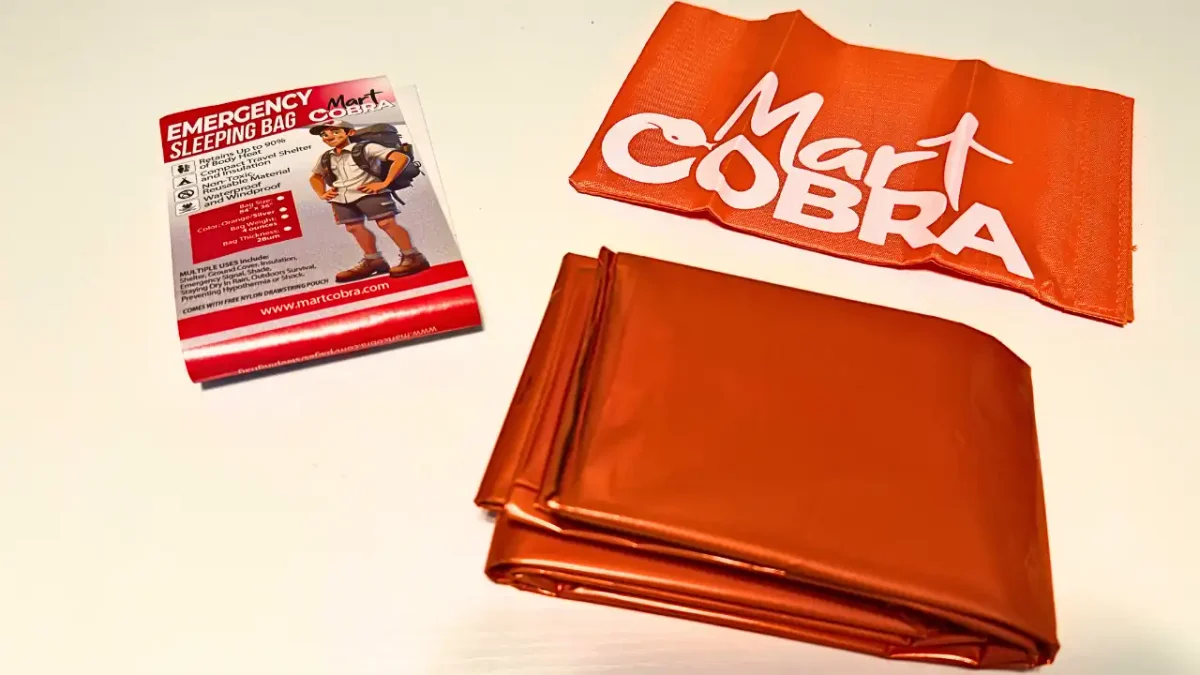
It arrives in a clear zip top bag with a spec card on the front. The card lays it out plainly: 84 by 36 inches, 4 ounces, 28 micron thickness, orange on the outside and silver on the inside. Inside that is a small orange Mart Cobra pouch, and inside the pouch is the bag itself, folded into a flat rectangle about the size of a paperback and not much thicker than a phone.
Unfold it and it becomes a real bag, not a blanket. It is sealed along the side and bottom, so you climb in rather than trying to wrap yourself in a sheet that keeps blowing open. At 7 feet long it fits a tall adult, and one reviewer over six feet said he had room to spare.
Here is why it works. Your body is constantly giving off heat. The silver mylar inside reflects that heat back at you instead of letting it radiate away, and the plastic shell blocks wind, which strips warmth faster than almost anything else when you are stopped and sweaty. The brand says it retains up to 90 percent of your body heat. Treat that as a best case number. The real point is simpler: it holds on to the warmth you are already making.
The orange outside matters too. If someone is looking for you, bright orange against snow, dirt, or a gray roadside is a lot easier to spot than a black jacket.
Now the honest part, because a bag this cheap and this light comes with tradeoffs.
It does not insulate you from the ground. Mylar reflects heat, but cold ground pulls heat out of you by direct contact, and a thin sheet of plastic does nothing to stop that. One reviewer lay in it on a cold floor and felt the chill come straight up through the bottom. Put something between you and the ground: your pack, a foam pad, a car floor mat, a pile of leaves. That single step makes a bigger difference than anything else.
It does not breathe. Moisture from your body has nowhere to go, so expect condensation on the inside after a while. Keep your face out of the opening and get into dry layers first if you can.
It is crinkly and loud. You will not forget you are sleeping in a potato chip bag.
And the thing I found out on camera: you are not getting it back into the factory fold. I tried. Once it is open, the realistic plan is to fold it loosely and stuff it back in the pouch or a zip bag. For a car kit or the bottom of a pack, that is completely fine.
Durability sits right where you would expect for 28 micron material. Some owners call it flimsy. Others have gotten several nights out of one, but even the happy reviewers suggest replacing it after a couple of real uses. Think of it as a one night save, not a piece of camping gear.
Is It Worth a Spot in Your Pack?
For most of the people reading this, yes.
If you ruck, day hike, run longer trail routes, ride, or just drive through real winters, this is the kind of backup that earns its 4 ounces the one time you need it. You will not notice it in a pack. You will absolutely notice not having it if you roll an ankle two miles from the car as the sun goes down and the temperature drops.
Owners are keeping them in glove boxes, motorcycle bags, and go bags, and that is where it shines. If you want a better value, the 3 pack makes sense: one for the car, one for your pack, one spare for whoever you are out there with.
Where it is not the right tool: planned overnight trips. If you are actually camping, you want a real sleeping bag and pad. If you want an emergency bivy you can use over and over, a breathable option like the SOL Escape costs several times more but handles condensation and repeated use much better. This bag is for the night you did not plan.
One tip before you toss it in your kit: open one at home first. Learn how it unfolds and which end is the opening, in good light with warm hands. The first time you handle it should not be in the dark when you are cold, tired, and a little scared. Then stuff it back in the pouch and forget about it until the day you are glad you did not.
Most of your miles will go exactly to plan. This is for the one that does not.
